

It's Report Tuesday. 4,200 sequences sent, 31% open rate, 2.1% reply rate, nine meetings booked. Somewhere at the bottom, the summary calls it strong engagement.
The report doesn't connect a single one of those meetings to a sales conversation that's going anywhere. No pipeline influenced. No qualified opportunities created. No cost per meeting held. Just activity, consolidated in a dashboard and delivered on time.
This is what most AI outbound vendors are selling right now: motion that photographs well.
The market's own numbers make the case
The AI SDR category is worth examining because the failure rate is high enough to be structural, not incidental.
Between 50% and 70% of AI SDR tools churn within a year. Only 2% of companies implement them in a way that sticks, according to a 2026 Salesmotion analysis of the category. A SaaStr survey of companies that had run outsourced SDR programs found that 7% called them "highly successful." Another 26% said they "sort of worked." The remaining 67% reported they didn't work at all.
That's the median experience.

The most instructive case study is 11x.ai. The company raised $74 million from Andreessen Horowitz and Benchmark — and lost 70% to 80% of its customers within months of the acquisition. ZoomInfo ran a one-month trial, found the platform performed worse than their own SDR team, and didn't renew. For months after, 11x continued listing ZoomInfo as a customer in sales calls and on its website. ZoomInfo's lawyers eventually sent a letter citing deceptive trade practices and trademark infringement.
The best-capitalized AI SDR company in the market couldn't keep ZoomInfo as a paying customer. That's worth sitting with before you sign a contract.
The math behind the meetings
Here's what a 2.1% reply rate produces when you run it forward.
Send 1,000 emails. At 2.1%, you get 21 replies. Not all positive — some are unsubscribes, out-of-office responses, polite rejections. Call it eight to ten genuine conversations. From those, you might book four meetings. Industry benchmarks put meeting-to-qualified-opportunity conversion at 25% to 40% for cold-sourced outreach, and cold-sourced opportunities close at 10% to 25%. Run those numbers end to end and you're looking at roughly one closed deal per 500 to 1,000 delivered emails, on a good campaign.
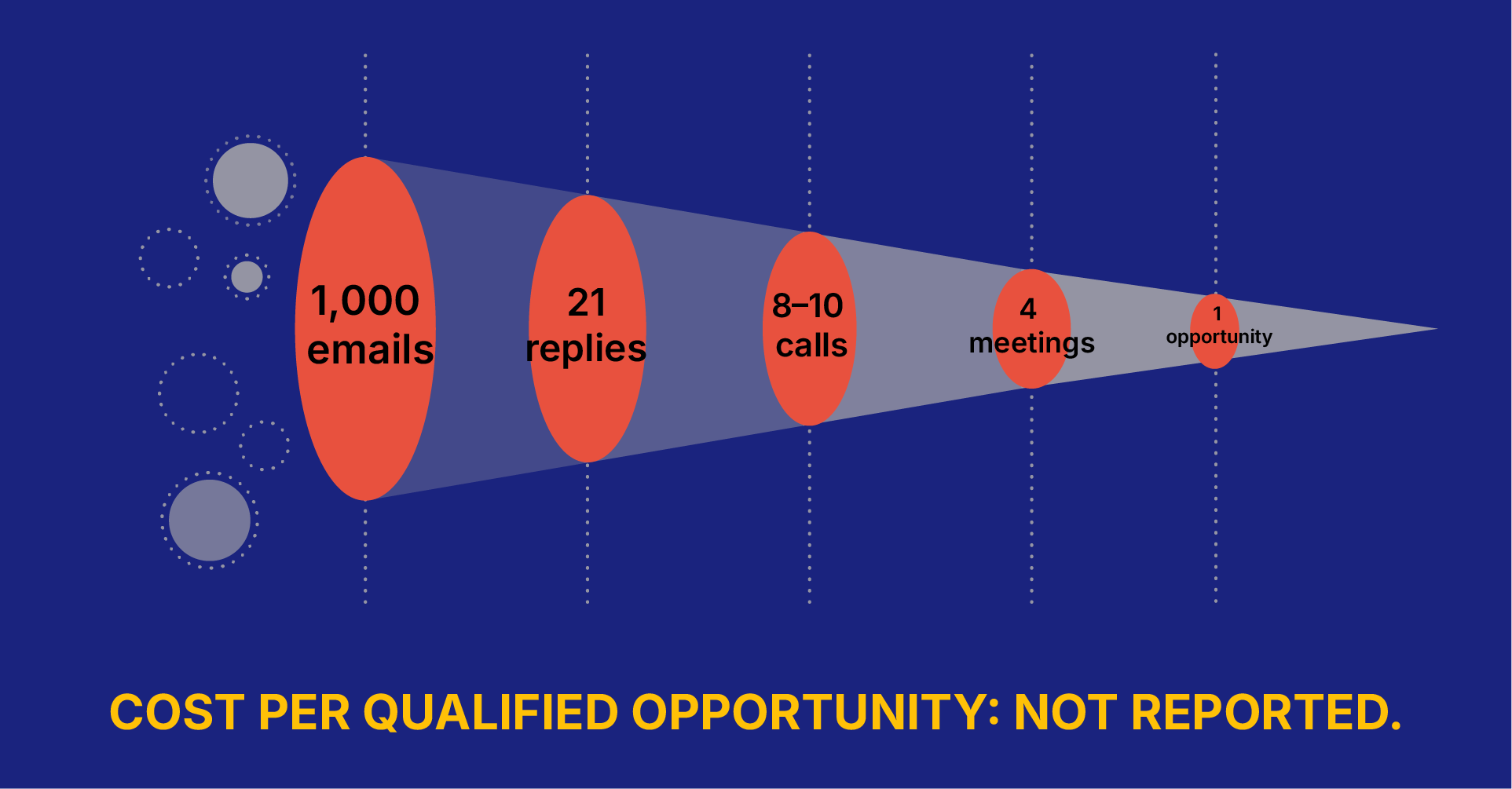
At $3,500 per month for a vendor managing that volume, the cost per meeting runs to $350 to $875 depending on show rate. The cost per qualified opportunity is higher. The cost per closed deal — if any close — is a number most vendors have never calculated for their clients, because nobody asked.
Meetings booked is where the funnel looks best. That's why it leads the report.
The Metric Hierarchy runs four tiers: Activity, Conversion, Pipeline, Revenue. Every number in that monthly report lives at Tier 1. A 31% open rate is Tier 1. A 2.1% reply rate is Tier 1. Nine meetings booked is, at best, early Tier 2. Nothing in that report reached Tier 3 — pipeline influence — which is the only tier that tells you whether the investment is producing anything.
That's not a vendor problem. It's a measurement problem. If you don't ask for Tier 3 data, you won't get it.
Volume is a large-company play
The economic case for AI outbound improves at scale. Jason Lemkin ran the experiment publicly: he replaced his GTM team with 20 AI agents, generated 10 times the email volume of a human team, and described the results as "better than a mid-pack SDR, not better than top performers." That honest assessment is the one vendors rarely quote in their pitch decks.
It works — to the extent it works — because Lemkin has the infrastructure to absorb and qualify 10 times the volume. A RevOps function, a CRM with pipeline tracking, a sales team with capacity to work what comes through.
For a 20-person staffing firm serving mid-market manufacturers in a single region, the math runs differently. The total addressable market might be 400 companies. An AI outbound campaign at volume will move through a meaningful portion of that list in 90 days. The firms that don't reply aren't neutral — they've now associated your name with cold outreach they didn't want. The ones who do reply need a follow-up system that most firms at this stage don't have.
Volume-first outbound is built for markets measured in tens of thousands. Professional services firms with defined geographic or vertical focus are not that market.
The same tactic that builds pipeline for an enterprise SaaS company quietly burns the list for everyone else.
What to do with the next report
There's a version of AI-assisted outreach that does work. Signal-based campaigns — triggered by a leadership change, a funding announcement, a hiring spike — achieve reply rates of 5% to 18%, compared to 1% to 3% for generic sequences.
The tool isn't the issue.
The targeting infrastructure behind it is. Most vendors selling to professional services firms in the $1M to $5M range aren't delivering the signal-based version. They're delivering templates with variable fields and calling it personalization.
When your next report arrives, pull up the Metric Hierarchy before you open it. Map every number your vendor gave you to a tier. If nothing reaches Tier 3 — no pipeline attributed, no qualified opportunities created, no revenue influenced — that's your data. Not a reason to fire the vendor immediately, but a reason to ask the question directly: what does this activity connect to downstream?
The answer tells you more about the engagement than any dashboard will.