

Here is a common scenario that plays out in thousands of businesses every month: a marketing team presents a report showing 50,000 impressions, a 2.1% click-through rate, and a 15% increase in social engagement. The founder nods, says "looks good," and moves on to the next agenda item.
Thirty days later, pipeline is flat. No new Sales Qualified Leads. Revenue has not moved. And nobody connects the dots back to that marketing report, because the metrics in it were never connected to revenue in the first place.
This is a metric-alignment problem, and it drains budgets from B2B professional services firms across every vertical. The issue is not that marketing is failing. The issue is that most firms are measuring activity when they should be measuring business impact.
Here’s the fix.
The four tiers: from vanity to revenue
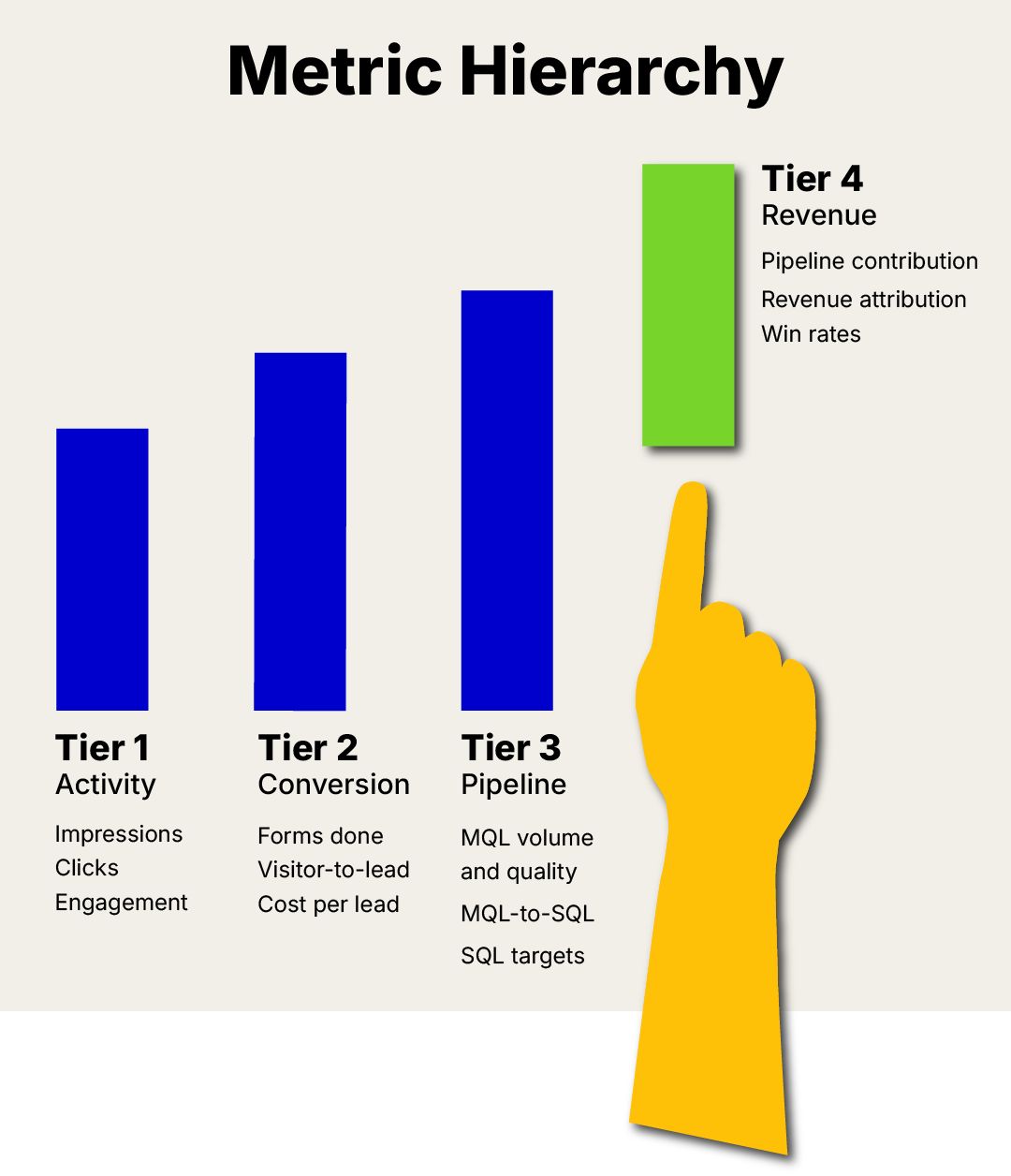
The Metric Hierarchy arranges marketing metrics into four tiers based on two dimensions: business impact and direct control. As you move from Tier 1 to Tier 4, the metrics become more meaningful to the business but harder for any single team to control. That tension is the entire point.
Tier 1: Activity metrics
Impressions, clicks, click-through rate, social media engagement. These metrics tell you that marketing is happening. They do not tell you whether marketing is working. An Instagram post can generate 10,000 impressions and zero pipeline. A LinkedIn ad can achieve a 0.65% CTR and still produce no qualified leads.
We track these. We report on them. But we never optimize for them in isolation. They are diagnostic signals, not outcomes.
Tier 2: Conversion metrics
Form completions, cost per lead, website visitor-to-lead conversion rate. Now we are getting closer to something meaningful. B2B professional services firms typically convert website visitors to leads at 4 to 6 percent, which is higher than most sectors because the traffic tends to be higher intent.
But a lead is not a customer. The average cost per lead across B2B industries sits around $198, with SaaS companies paying north of $300. These numbers matter as health indicators, but they are still one step removed from revenue. A firm can generate hundreds of leads per month and still miss its growth targets if lead quality is poor.
Tier 3: Pipeline metrics
MQL volume and quality, MQL-to-SQL conversion rate, SQL targets. This is where the conversation should live for most B2B professional services engagements.
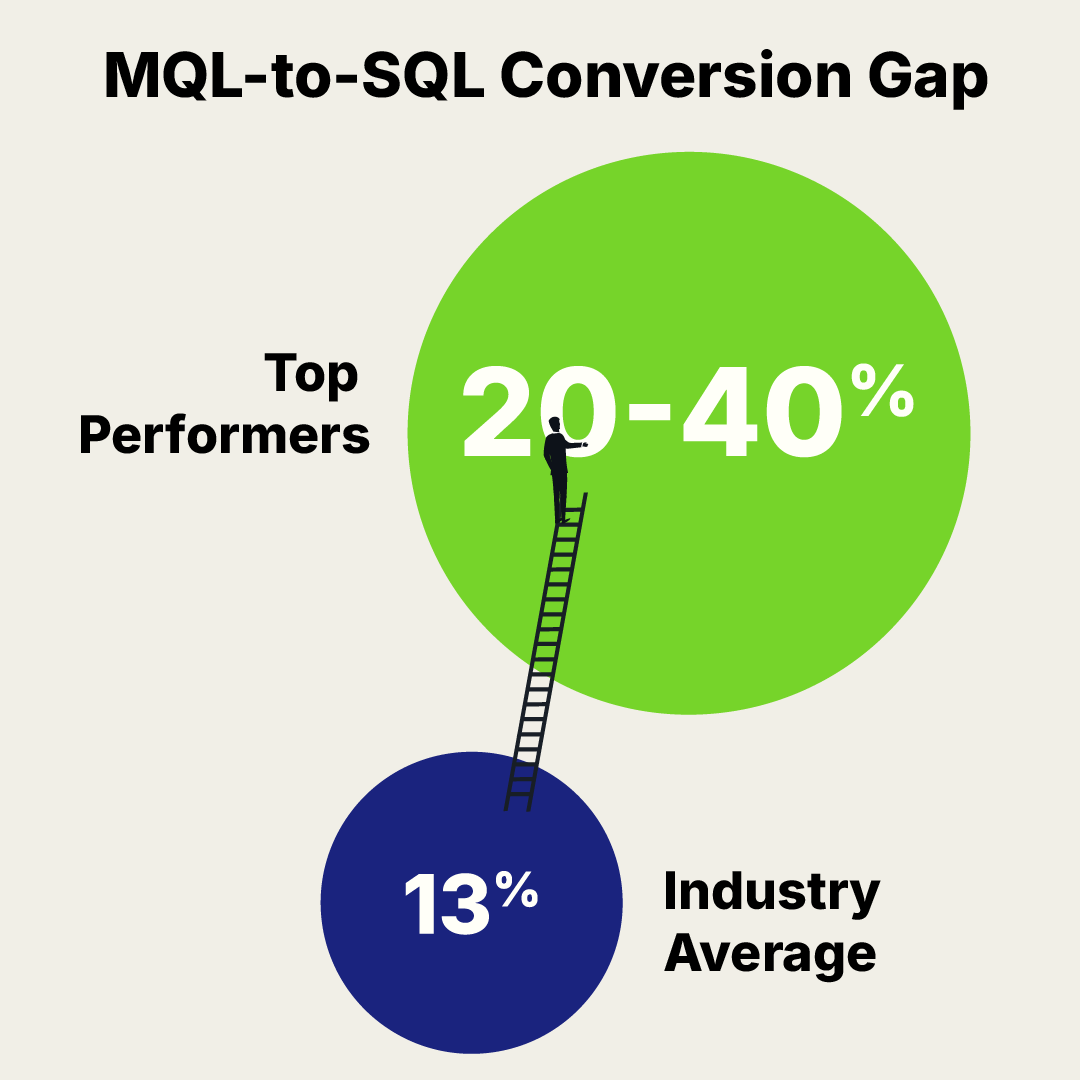
The industry average MQL-to-SQL conversion rate is 13%. Top performers operate at 20 to 40%. That gap represents the difference between marketing that generates noise and marketing that generates revenue.
The reason this tier matters so much for professional services is the economics of long sales cycles. When a single engagement might be worth $50,000 to $500,000 or more, the difference between a 13% and a 30% MQL-to-SQL conversion rate is not incremental. It is transformational. Every SQL that enters the pipeline has outsized revenue potential.
Tier 3 is also where attribution becomes both more important and more difficult. Marketing can generate the MQL, but whether that MQL converts to an SQL depends on lead scoring accuracy, sales team follow-up speed, and the quality of the nurture sequence. This is shared territory, and it requires shared measurement.
Tier 4: Revenue metrics
Pipeline contribution, customer acquisition cost targets, revenue attribution, win rates. This is the real scoreboard. Healthy SaaS and professional services teams target a 12 to 18 month CAC payback period. Anything longer signals either overspending on acquisition or underperforming conversion.
Getting to Tier 4 requires something many marketing relationships often lack: deep trust and shared data. It means the agency or marketing team has CRM access. It means both sides agree on attribution methodology. It means finance, sales, and marketing are looking at the same dashboard.
This level of organizational alignment is a challenge, but it’s where the value lives.
Why most marketing stays stuck at Tiers 1 and 2
You hire a marketing agency or build an internal team. The first reports come in filled with Tier 1 and Tier 2 numbers because they are easy to capture, always trending in some direction, and that is the only data available in the early going.
Over time, you begins to feel a disconnect. Revenue is not growing at the rate the marketing reports would suggest. But because nobody established Tier 3 or Tier 4 baselines at the beginning of the engagement, there is no framework for accountability.
This is not a marketing execution problem. It is a measurement architecture problem. And it needs to be solved during the sales process.
How we weight performance for B2B professional services
For clients with long sales cycles, high-trust buying decisions, and significant deal sizes, we weight our performance metrics as follows:
Notice that 70% of the weight sits at Tier 3 and 30% at Tier 4. SQL volume and conversion rates are metrics marketing can meaningfully influence through targeting, content quality, lead scoring, and nurture sequences. Pipeline contribution involves sales execution as well, which is why it carries the highest alignment value but is weighted at 30% rather than 50%.
This structure creates a clear contract: marketing is accountable for filling the pipeline with qualified opportunities and ensuring those opportunities convert at above-market rates. If we do that well, pipeline contribution naturally follows.
What this means for your marketing
If you are a founder or managing partner at a B2B professional services firm, the Metric Hierarchy gives you a practical lens for any marketing conversation.
Start by asking where your reporting lives at. If the answer is overwhelmingly Tier 1 and Tier 2, you have a measurement problem before you have a performance problem.
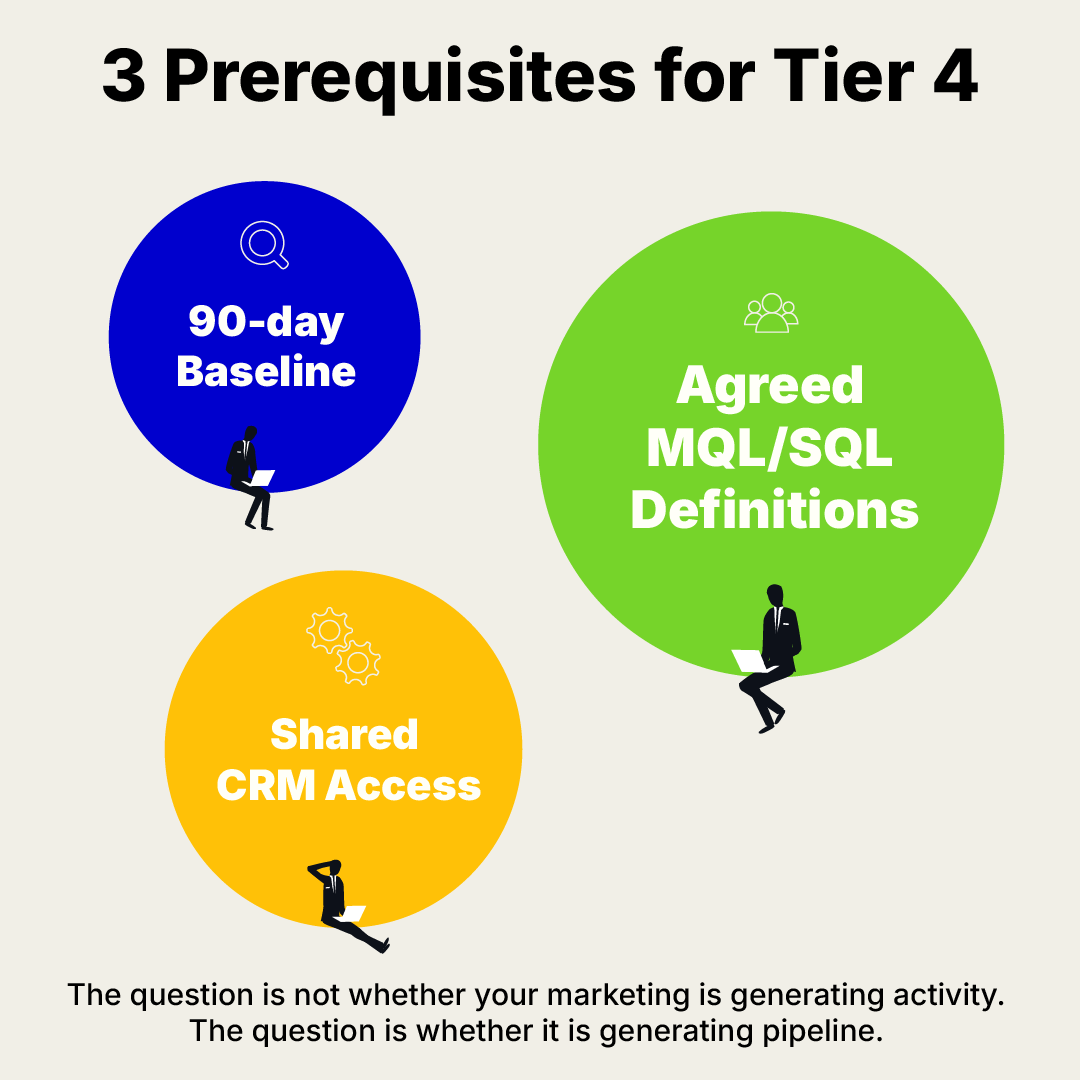
Then ask what it would take to get to Tier 3. The answer almost always involves three things: shared CRM access so both sides see the same data, agreed definitions for MQL and SQL so there is no ambiguity about what counts, and a 90-day baseline period before performance metrics activate so the data is clean and fair.
These are not unreasonable asks. They are the foundation of a marketing relationship that actually connects to revenue. And in our experience, the firms willing to set this up retain their marketing partners for years instead of months and see meaningfully better results.
Control versus influence
The reason marketing often avoids Tier 3 and Tier 4 metrics is straightforward: you cannot fully control them. An agency can write the best nurture sequence in the world, and if the sales team takes five days to follow up on a hot lead, the MQL-to-SQL rate collapses. A marketing team can drive record pipeline, and if the product has a fundamental positioning problem, win rates stay flat.
But control is not the point. Influence is.
Winning marketing teams that measure what matters to the business, negotiate access to influence the numbers, and report to affix accountability.
Activating the Framework
The Metric Hierarchy is the operating model we use for every engagement. It shapes how we structure contracts, how we build dashboards, how we run quarterly business reviews, and how we hold ourselves accountable.
If you're investing in marketing and your reports stop at impressions and click-through rates, you deserve better. Not because those metrics are useless, but because they are insufficient. They tell you the engine is running. They do not tell you the engine is taking you anywhere.
The question is not whether your marketing is generating activity. The question is whether it is generating pipeline.