

New Businesses are Entering the US Market at a Blistering Rate
The US Census Bureau tracked roughly 400,000 to 450,000 new business applications every month throughout 2025. Applications for Employer Identification Numbers — the administrative counterpart to starting a real business. From November 2025 alone, the Bureau projected more than 31,000 new employer businesses forming within the year.
Most of them are in your market.
You Will Hit a Ceiling
Now fast-forward three years. The firm that filed in 2022 is past $1M. It has clients, a reputation, and a referral network that carried it here. It also has a LinkedIn the founder posts to when she remembers, a website, and a monthly newsletter. Revenue has been flat for eighteen months. The referral network is still there — it's just tapped.
It's a ceiling, and almost every professional services firm hits it at roughly the same place.
Somewhere between $1M and $2M, the founder's direct network saturates. The people who know you and trust you have either hired you or referred you. The next wave of clients has to come from somewhere else — and "somewhere else" requires a system, not a personality.
Marketing spend at this stage typically runs $2,000 to $4,000 a month. The budget exists. What doesn't, in most cases, is a structure to deploy it against.
Recognize the Signs of Ceiling Syndrome
The typical $1M–$3M professional services firm from the outside:
The founder speaks at two industry events per year. She posts on LinkedIn after each one, gets a flurry of connection requests, and has no mechanism to capture or follow up with any of them. The firm sends a holiday card. The website has a contact form that routes to a shared inbox.
We recently spoke with a KYC/AML organization that fits that profile: great quarterly event programming combined with inconsistent advance event promotion and dwindling posting and reposting in the event aftermath. It’s left them with the (accurate) sense that they aren’t leveraging their LinkedIn presence effectively.
Founders at this stage typically spend too much time on marketing-adjacent activity — writing, networking, referral cultivation, speaking. Without a framework connecting that activity to pipeline, it resets every quarter. The posts from last March are gone. The event connections went cold.
The Antidote
A functional marketing OS at the $1M–$3M stage has four components. None are technically complex. Most firms are missing at least three.
Content Cascade
One piece per week, on a defined schedule, written to a specific reader. A rhythm — same day, same format, same distribution path. The piece doesn't have to be long. It has to be consistent.
Capture Mechanism
Something on every page of the website and at the bottom of every email that converts a visitor into a contact. A newsletter signup. An audit offer. Correctly done, a capture mechanism turns attention into a relationship.
Nurture Track
A sequence of five to seven emails that runs automatically after someone joins the list. Orient them to your organization. What do you believe? What do you see that your clients miss? Why does your approach produce different results? The nurture track is the conversation that happens at scale instead of one lunch at a time.
Calibrated Measurement
One dashboard. Four numbers, reviewed monthly: new contacts added, open rate on the nurture sequence, website sessions, and meetings booked from marketing channels. Four numbers that tell you whether the system is working.
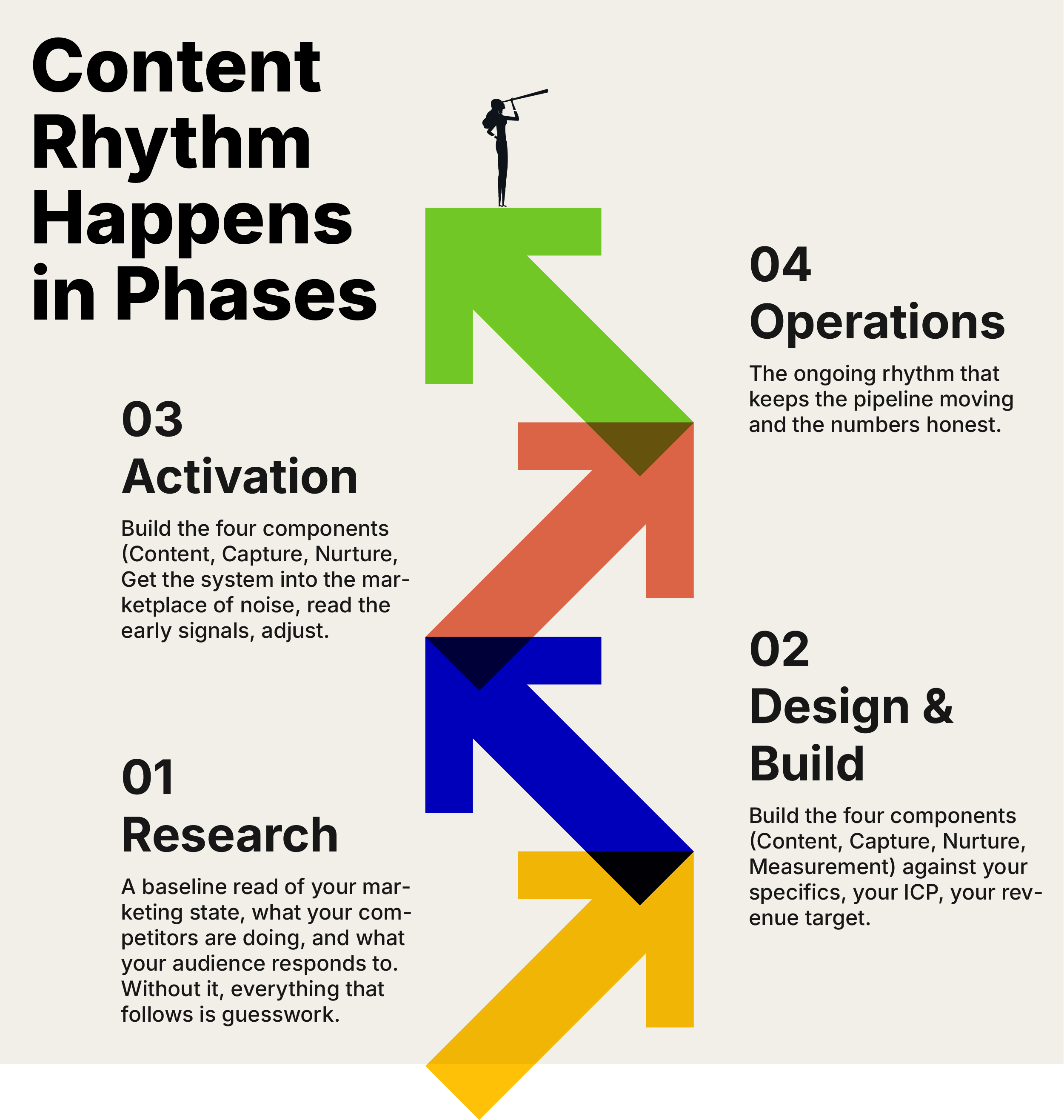
Content Rhythm Happens in Phases
First, Research
A baseline read of your marketing state, what your competitors are doing, and what your audience responds to. Without it, everything that follows is guesswork.
Then Design & Build
Build the four components (Content, Capture, Nurture, Measurement) against your specifics, your ICP, your revenue target.
Then Activation
Get the system into the marketplace of noise, read the early signals, adjust.
Then Operations
The ongoing rhythm that keeps the pipeline moving and the numbers honest.
Most firms skip straight to Activation. Hire, start posting, run ads, then wonder why nothing compounds. The sequence matters because each phase produces the inputs that the next one runs on.
The output is a pipeline that moves whether the founder is billing, traveling, or sick. A system that operates independently.
Objection
A firm at $1.5M should focus on delivery and sales rather than marketing infrastructure. Fair enough: a founder who spends thirty hours architecting a content system when she has three open client slots is solving the wrong problem.
But none of what's described here requires a marketing department.
The content engine runs with one part-time operator and a defined brief. The capture mechanism is a form and a thank-you page, built once. The nurture sequence is seven emails, written once, reviewed annually. The measurement layer is a dashboard that takes ninety minutes to set up.
The argument isn't "do marketing instead of sales." Stop treating marketing as something that happens when everything else is done. At this revenue stage, that posture is expensive — it just doesn't show up on the income statement as a line item.
Referrals Only Get You So far
Every firm in this band hits the same inflection: the referral network that built them isn't big enough to take them further. The firms that cross $3M cleanly aren't the ones that landed a perfect referral at the right moment. They built a structure — minimal, consistent, connected — and ran it long enough for it to compound.
The firms that didn't are still waiting for the phone to ring.
If you don't know what your marketing should be measuring at your current revenue stage, that's the first thing to fix — before the agency conversation, before the content calendar, before anything else. That's what the Research Phase is for.