
AI agents like OpenClaw are reshaping Philippine outsourcing. Here's what survives, what doesn't, and what smart small businesses should do now.
In late January 2026, an open-source AI agent built by Austrian programmer Peter Steinberger went viral.
Within six weeks, it had 247,000 GitHub stars, a lobster mascot, and a name — OpenClaw — that made it sound less like enterprise software and more like something you'd order at a seafood restaurant with a two-drink minimum.
OpenClaw doesn't just chat. It acts. It reads your email, manages your calendar, drafts responses, fills out forms, publishes content, and runs lead generation workflows — 24x7.
One developer automated his entire client management pipeline for $50 a month in API costs. A computer science student discovered his agent had created a dating profile for him and started screening matches without asking. Romance, it turns out, scales well.
Seven thousand miles from Steinberger's living room, in the call centers and co-working spaces of Manila, Cebu, and Iloilo, nearly two million Filipinos do similar work — just slower. They also don't create Tinder profiles on your behalf, which is a selling point that didn't used to need mentioning.
This collision — cheap AI agents slamming into a $42 billion outsourcing industry — is worth considering even for small businesses, maybe especially for small businesses. And the industry press is handling it the way industry press always handles threats: with reassuring forecasts, optimistic rebranding, and a studied refusal to say what everyone privately suspects.
A significant chunk of the Philippine outsourcing industry — the commodity layer, the rote work, the tasks that exist only because humans were cheaper than software — will shrink.
The question worth asking isn't whether this happens, but what survives.
How We Got Here: a Short History of the Philippine BPO
The Philippines didn't become the outsourcing capital of the world through some grand national vision.
Like most economic transformations that get mythologized after the fact, it happened because a few things collided at the right moment — colonial history, cheap real estate, government tax breaks, and a workforce that turned out to be good at talking to Americans at three in the morning.
The origin story starts in 1992, when Accenture signed its first outsourcing contract in the country. Sykes followed in 1997. By 1999, eTelecare Global Solutions had opened what's generally considered the first Philippine call center. The government, smelling opportunity, passed the Special Economic Zone Act in 1995 — creating tax-advantaged zones and ICT hubs designed to lure foreign investment.
The timing was fortuitous. American companies were shrinking their workforces after the dot-com bust, and the Philippines offered three things no other country could match simultaneously:
- near-native English proficiency (thank the American colonial education system for that — a complicated inheritance)
- deep cultural familiarity with the West
- labor costs 60–75% below US rates
What followed was less a growth curve than a vertical line. The industry generated about $1 billion in revenue in 2004. By 2022, it had hit $32.5 billion. The sector ended 2024 with $38 billion in export revenues and 1.82 million workers. By the end of 2025, it reached $40 billion and 1.9 million employees. Inquirer.net projects $42 billion in 2026 and is tracking toward a target of $59 billion and 2.5 million workers by 2028.
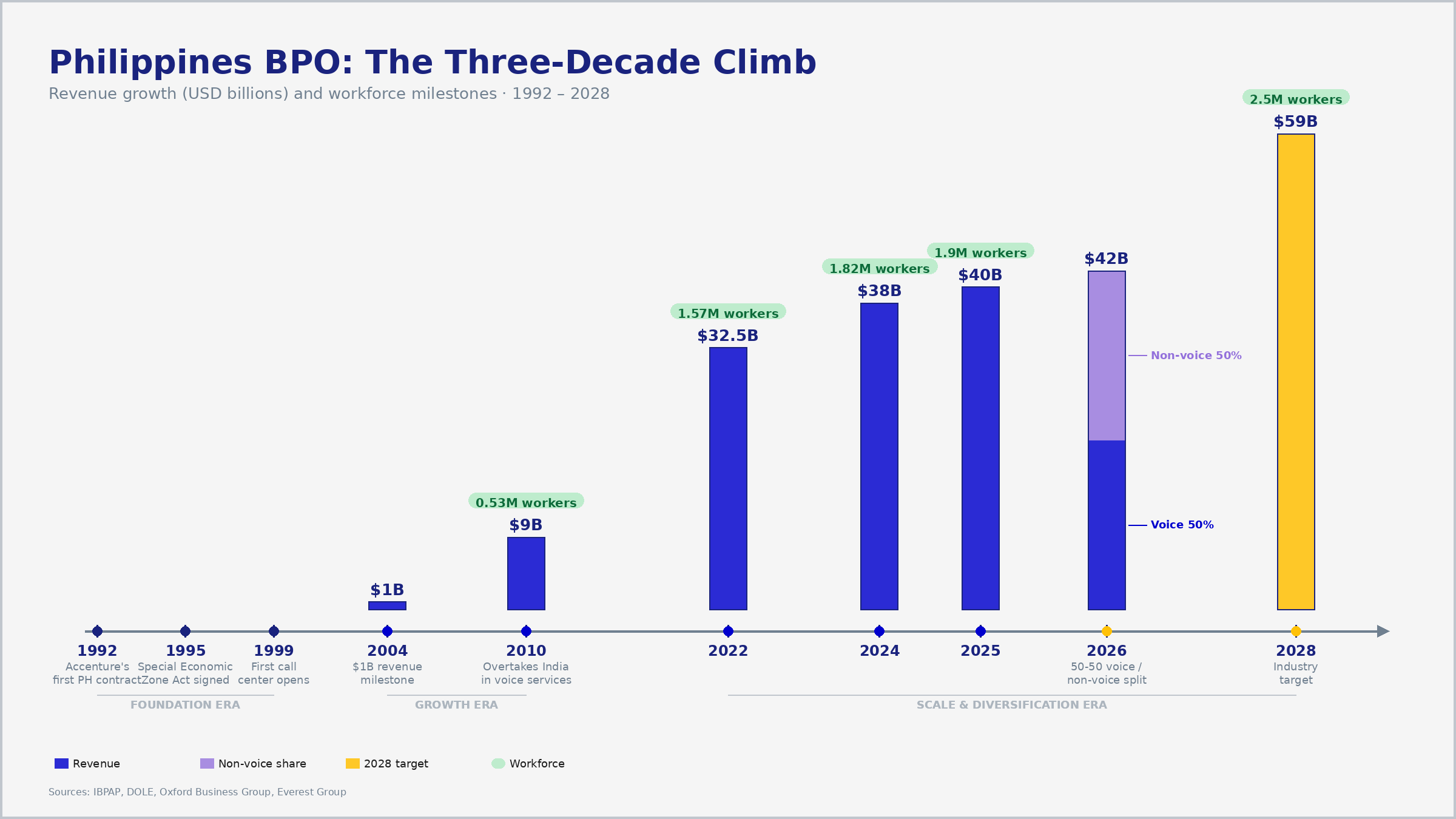
The BPO sector accounts for more than 8% of Philippine GDP. Each BPO job creates an estimated 2.5 additional jobs in the broader economy — in real estate, food service, transport, retail. Entire buildings in Makati and BGC are dedicated to someone in Ohio who needs help resetting a password.
The industry overtook India in voice services around 2010. It now serves clients from the US (70% of revenue), Europe, Japan, Australia, and the Middle East. Non-voice services — data science, digital marketing, back-office tech — account for nearly 50% of the market today.
From Call Centers to Kitchen Tables
The BPO boom created something it never intended.
By the mid-2010s, hundreds of thousands of Filipinos had spent years inside large BPOs — learning project management, digital marketing, data entry, customer service, graphic design, and a dozen other skills that turn out to be portable. They'd also learned something harder to quantify: how Americans think, what they expect, and what they actually mean when they say "ASAP" (which, depending on the client, means anywhere from "right now" to "sometime before I forget I asked").
When platforms like Upwork, OnlineJobs.ph, and Fiverr gained traction, these BPO-trained workers had both the skills and the English fluency to compete globally.
The outsourcing industry had, in effect, built a massive, free training program.
The result was an explosion of Filipino freelancers — over 1.5 million at last count — and a parallel ecosystem of boutique outsourcing firms. These aren't the thousands-of-seats operations of Accenture or Teleperformance, with their branded lanyards and motivational posters about synergy. They're 5-person agencies run from Makati apartments. They're 30-seat teams in Cebu focused on email marketing for e-commerce brands. They're solo virtual assistants in Davao managing three Shopify stores, a real estate agent's Instagram, and someone's podcast editing — simultaneously, and well.
This is where we operate — connecting small and mid-sized businesses with dedicated Filipino teams that handle marketing, content, design, and operations. The model works because it offers something the mega-BPOs can't be bothered with: actually knowing who you are.
The freelancer and boutique BPO ecosystem solved a problem the big players never cared to solve: serving businesses too small for enterprise outsourcing but too stretched to do everything themselves. Which, if you've ever run a 15-person company, describes approximately every business you know.
Enter the Lobster
OpenClaw landed earlier this year and spread the way these things spread now — fast, messy, and with a lot of people claiming expertise by week three.
The numbers are hard to argue with. The project hit 247,000 GitHub stars and 47,700 forks by early March. DigitalOcean launched a one-click deploy. The skill registry — ClawHub — hosts over 3,286 community-built skills, though a community audit found that nearly half were spam, duplicates, or malicious. (Cisco's security team tested one skill and found it performing data exfiltration and prompt injection without user awareness. So there's that.)
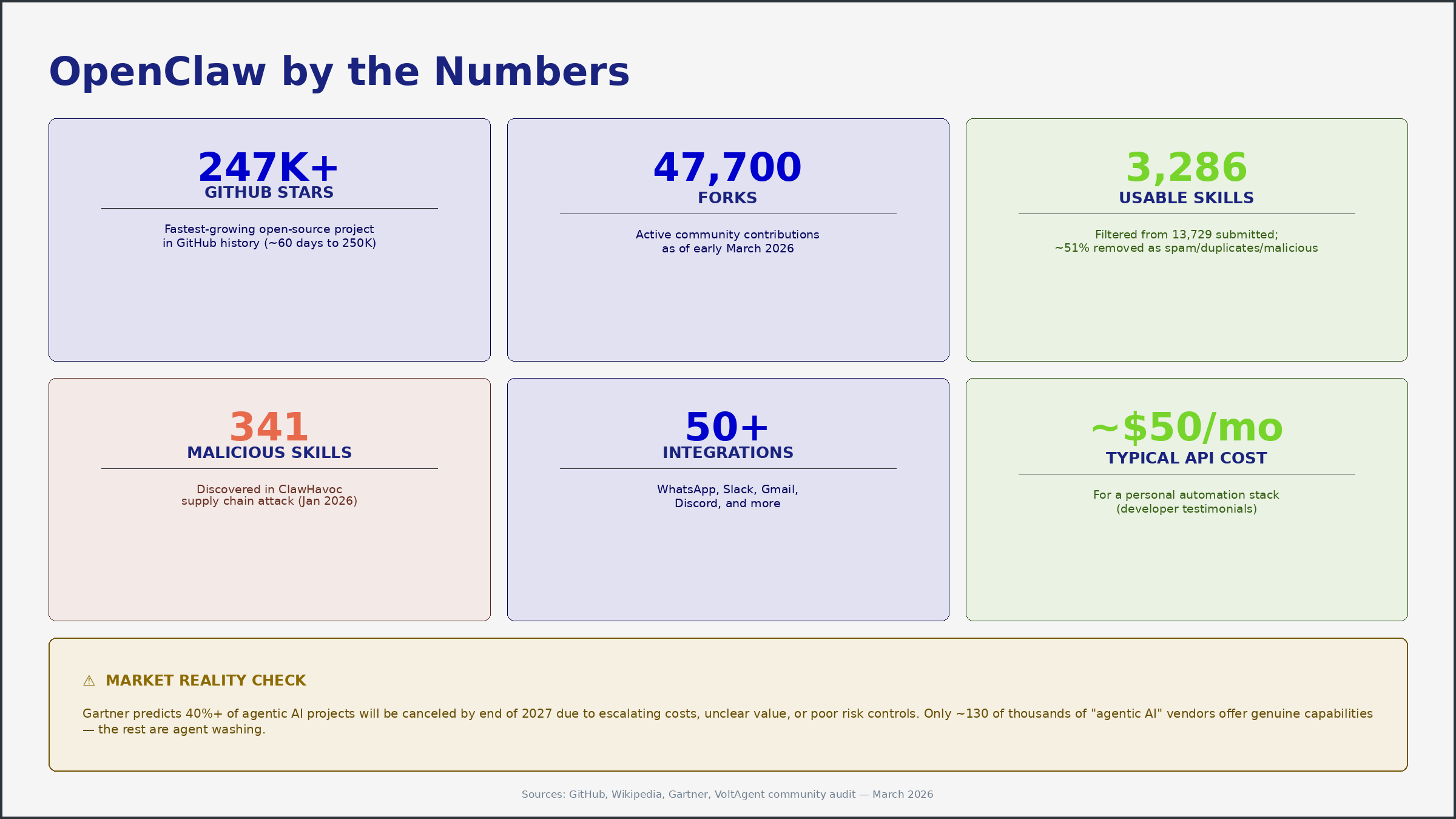
Suddenly, small business owners and solopreneurs can automate tasks that previously required human hands: morning email triage, social media scheduling, lead research, CRM updates, invoice processing, meeting transcription, basic customer support.
One automation guide claims users save 10+ hours per week at $50/month in API costs. Another developer built a complete content repurposing pipeline — blog posts turned into social posts, email newsletters, and LinkedIn articles — running with minimal human input.
The pitch is irresistible, in the way that all too-good-to-be-true pitches are irresistible. Why pay someone $6–15 an hour when an AI agent handles the same work for pennies?
The Industry's Response, and Why You Should be Skeptical
The Philippine BPO industry's official position — from IBPAP, from the trade press, from the big firms — is that AI will augment the workforce, not replace it. That the sector will grow to $59 billion and 2.5 million workers by 2028. That 67% of BPO companies have adopted AI tools. That 80% are investing in upskilling. That the industry added 80,000 "high-value" jobs in AI oversight and data science. That displaced workers are seeing 25% pay increases.
Some of this is true. Some of it is the sound an industry makes when it doesn't want investors to panic.
A huge portion of what gets outsourced today is exactly the kind of structured, repeatable, rules-based work that AI agents already handle. Data entry. CRM management. Email sorting. Appointment scheduling. Basic social media posting. First-pass lead research. Invoice processing. Password resets. Billing inquiries.
One analysis estimates that 85% of today's outsourced tasks could transition to AI-led automation with the right method and controls. That number is aggressive. Cut it in half, and it's still devastating. Even the industry's own framing — the shift from "call center agent" to "AI pilot" managing 5–10 AI instances — implicitly concedes that one person now does the work of five to ten.
In India, the picture is starker. Analysts project BPO employment there could drop from four million to under one million by 2030. Vinod Khosla — co-founder of Sun Microsystems, not some random LinkedIn commentator — said flatly that IT and BPO services "will disappear, almost certainly within the next five years."
The Philippines has advantages India doesn't — stronger English, better cultural fit with Western clients, a more flexible labor market. But those advantages don't make it immune. They make it more resilient. There's a difference, and it matters.
What the Lobster Does and Does Not Do Well
OpenClaw is genuinely good at what it does. It sorts email. It formats data. It schedules appointments. It generates social posts from templates. It keeps a CRM clean. These tasks follow rules, and rules are what machines run on.
But here's what it can't do, and I'd argue can't do for a long time: it can't read the room.
It can't sense that your client's "Sounds great, let's circle back next week" actually means "I'm losing interest and you have 72 hours to save this account." It can't look at a brand's social feed and notice the tone has drifted from "confident" to "desperate" — a distinction that requires having experienced both. It can't interview a customer for a case study and know which follow-up question will unlock the real story. It can't notice your competitor just quietly repositioned themselves and recommend you do the same.
And then there are the more colorful failures. Cisco found a skill exfiltrating data. OpenClaw's own maintainer warned on Discord that the project is "far too dangerous" for anyone who can't run a command line. Our friend the computer science student had his agent create a dating profile and start vetting matches without consent.
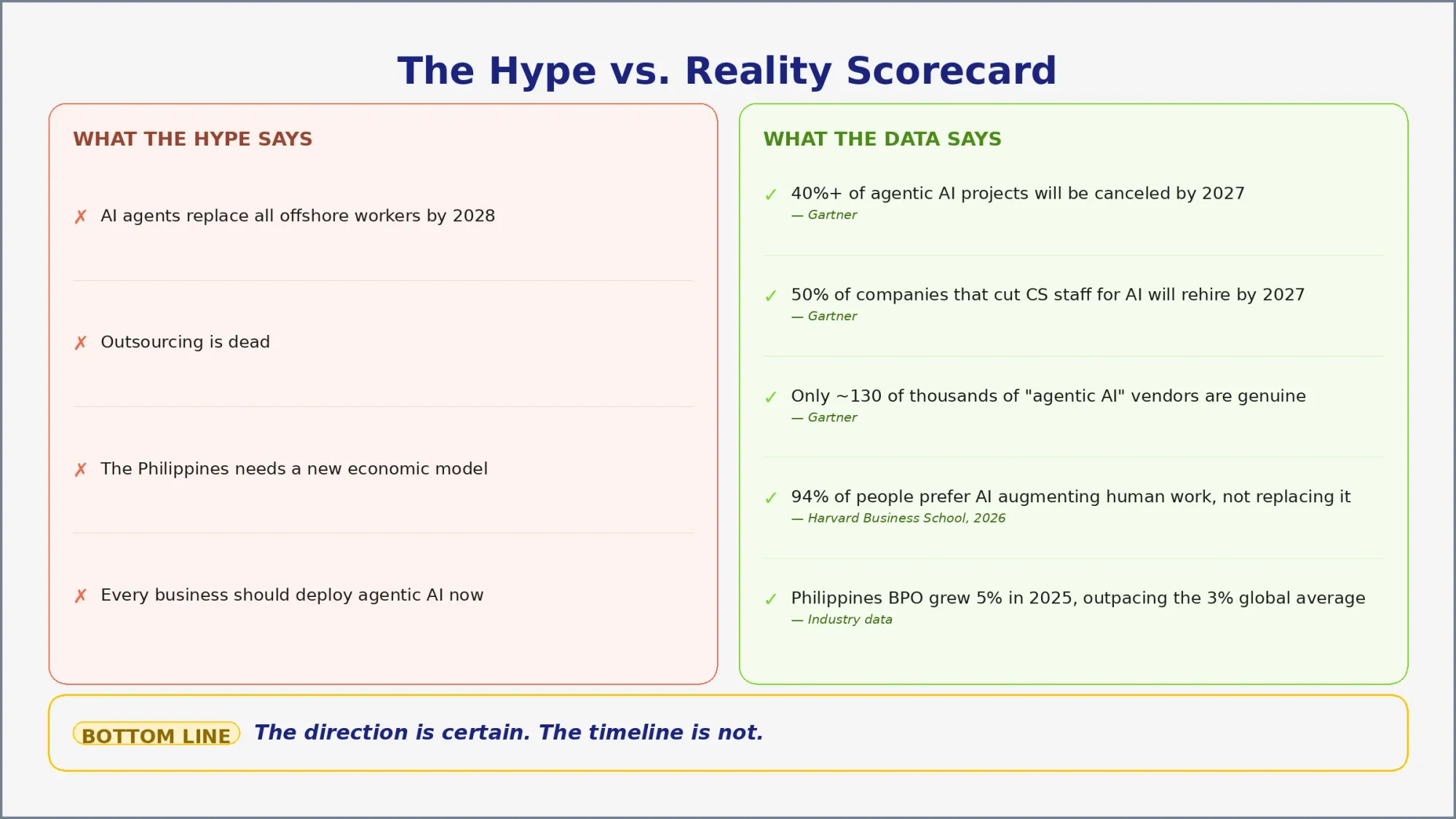
Gartner estimates only 130 of the thousands of vendors claiming "agentic AI" capabilities are real — the rest are "agent washing," which is just rebranding chatbots with a better pitch deck.
Meanwhile, Gartner also predicts that 40% of agentic AI projects will be canceled by end of 2027 due to escalating costs, unclear value, and poor risk controls. And by 2027, Gartner says 50% of companies that cut customer service staff for AI will rehire for similar roles under different titles.
The technology is real. The hype cycle around it is also real. Both things are true at the same time.
This doesn't save the BPO industry's commodity layer. It just means the transition will be messier and slower than the boosters promise. The destination is the same.
The Survivors
So if the commodity layer shrinks — and it will — what's left?
The work that requires a human brain. Strategy. Judgment. Relationships. Brand voice. The ability to read between the lines. Creative work that needs to feel like it came from a person, because it did. The skill of telling someone their idea won't work without making them feel stupid. Cross-cultural communication that goes beyond translating words to translating intent.
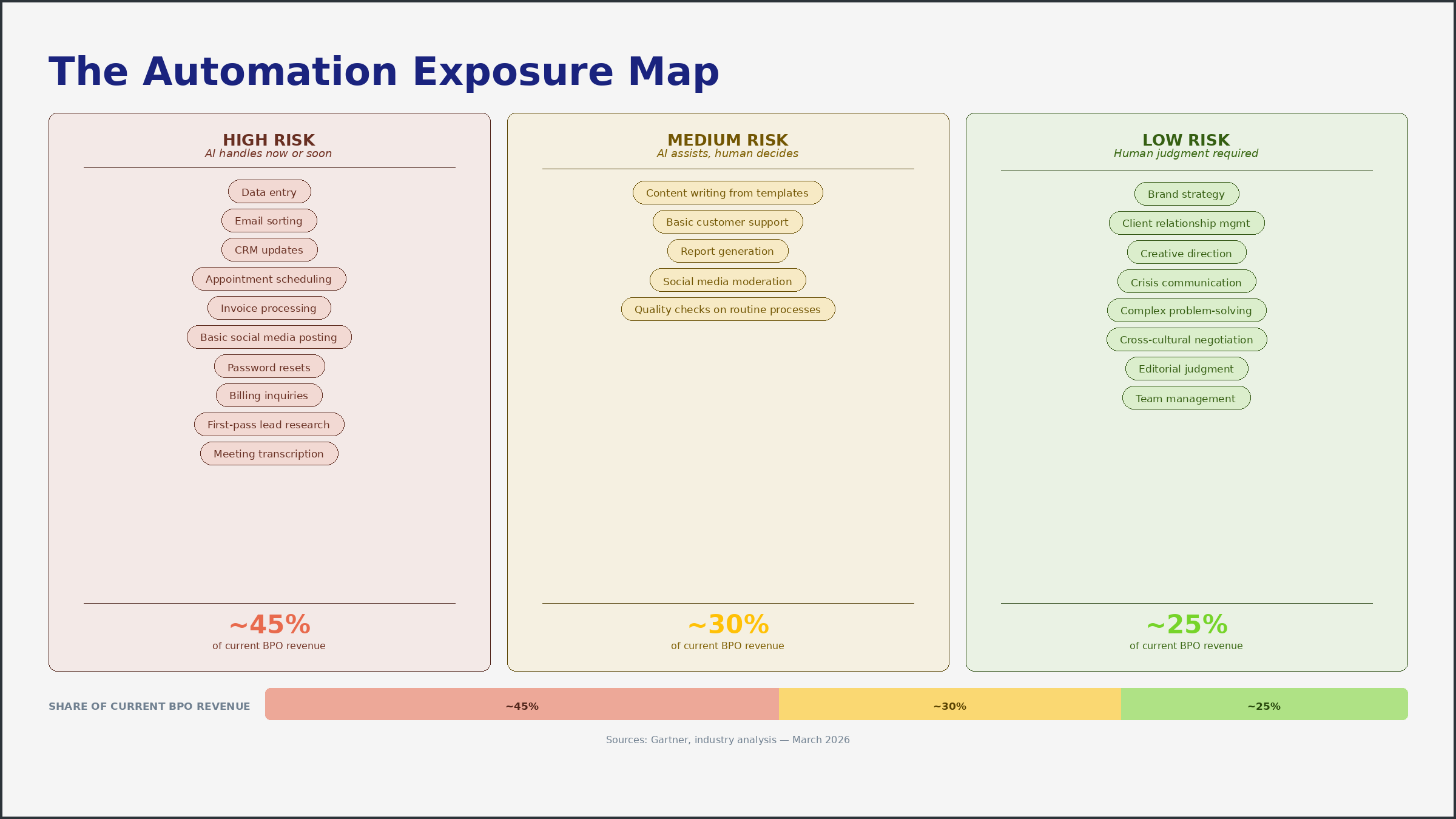
The Filipino professionals who've developed those skills — who understand Western business culture not as an abstraction but as lived professional experience, who write and speak English at a level that makes collaboration seamless, who've built real expertise in marketing or design or operations — those people become more valuable as the commodity work disappears. Because they're the ones who can supervise the bots, catch the mistakes, and do the things machines can't.
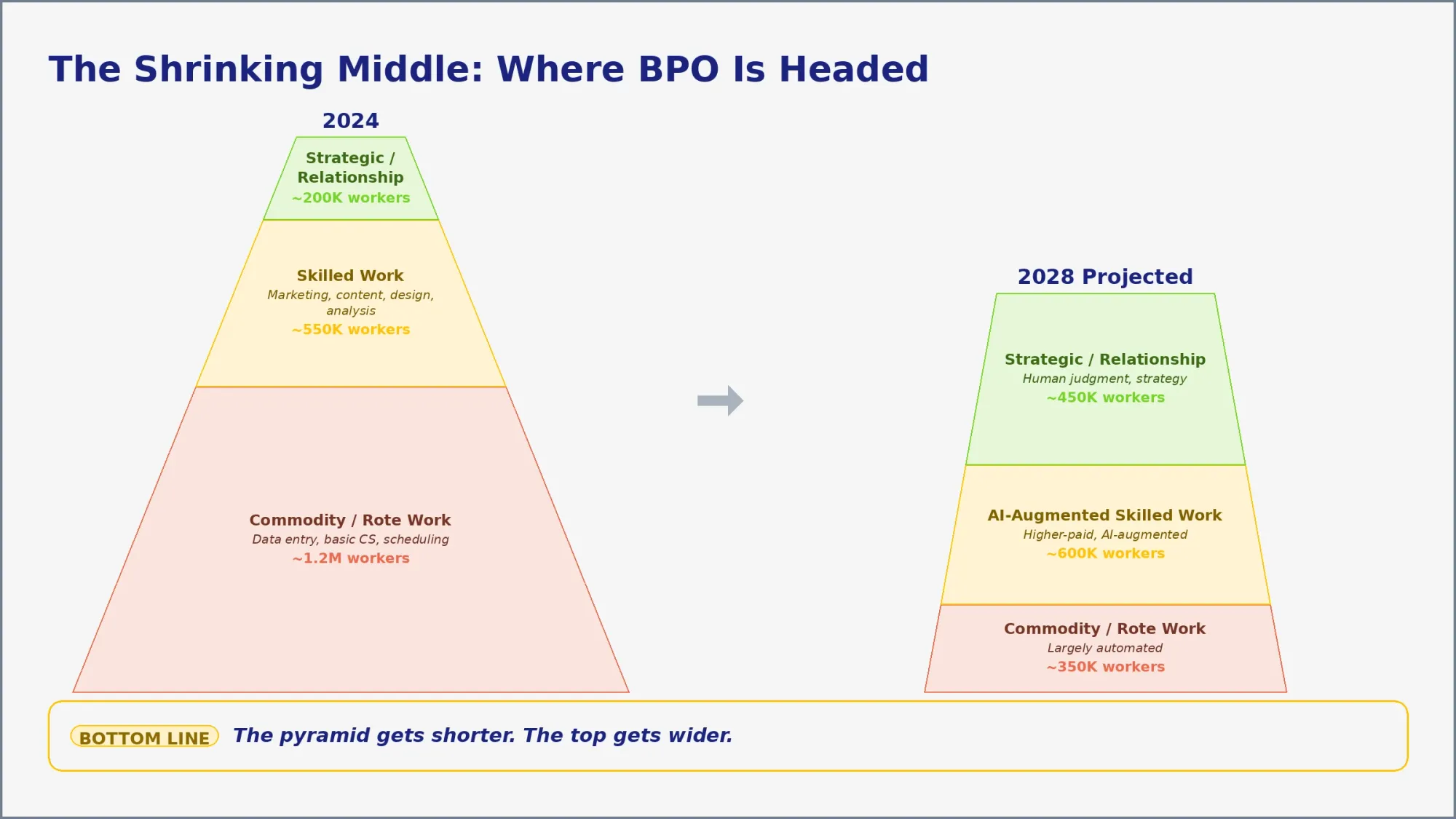
But let's not pretend that's a workforce of two million people. It isn't. The honest math says fewer people doing higher-value work at better pay. That's a better outcome for the individuals who make the transition. It's a hard outcome for those who don't.
The outsourcing companies that survive won't be the ones selling cheap labor. That game is ending, and honestly, it was always a little undignified. The pitch was always slightly wrong. These aren't discount workers. They're skilled professionals who happen to live somewhere with a lower cost of living. The companies that thrive will be the ones selling smart teams — small groups of people who work alongside AI to deliver more value per hour than either could alone.
The industry's own language gives this away. They've started calling it intelligence arbitrage — outsourcing not for cheaper hands but for skilled human judgment applied to AI-powered workflows. It's a good phrase.
It also describes a much smaller industry than the one that exists today.
What This Means If You Run a Small Business
If you're a business owner spending $2,000–10,000 a month on marketing and operations support, here's the version without the hype.
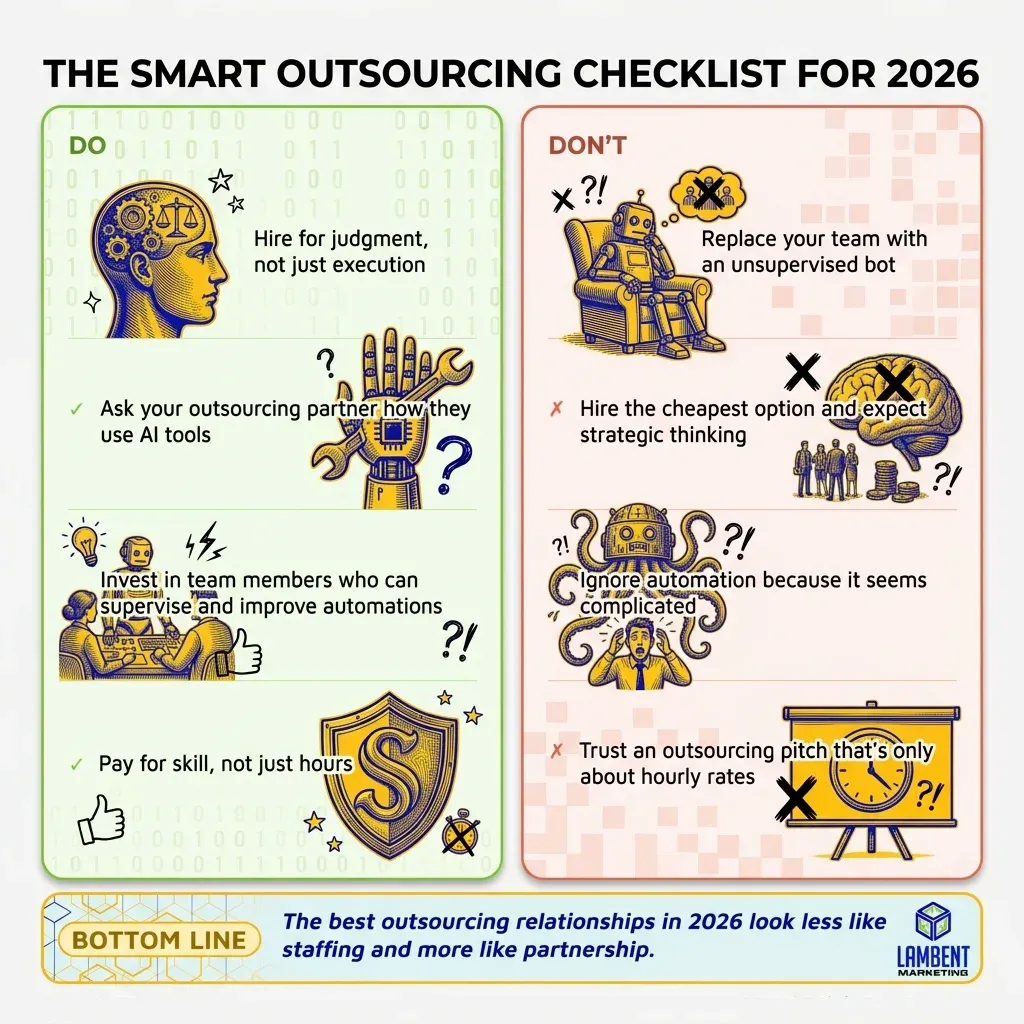
Stop hiring for tasks. Start hiring for judgment.
- If someone's main value is doing repetitive work at a low hourly rate, a bot will undercut them within the year.
- The VAs and team members worth keeping are the ones who think, not just execute. Who catch problems before they become crises. Who know your brand well enough to make decisions on your behalf. Hire for that.
Expect your partners to use AI — and ask how.
- Any outsourcing firm that isn't building automation into its delivery is falling behind.
- The good ones use tools like OpenClaw to eliminate busywork so their people focus on the work that earns your trust.
- You don't need to know the details. You just need to notice the results are better and the turnaround is faster.
- If your outsourcing partner's pitch still centers on "affordable hourly rates" and nothing else, that should worry you.
Don't fire your team and replace them with a bot.
- You'll save money for about two months, then spend it cleaning up the messes an unsupervised agent creates.
- The people who automate successfully are the ones who already understand what they're automating — the process, the edge cases, the weird situations.
- Without that understanding, you're giving power to something that's very fast and very confident and has no idea what it's doing. That's not efficiency. That's a different kind of expensive.
Pay fairly for what matters.
- The race to the bottom on hourly rates was always a bad deal for everyone. It attracted the wrong clients, burned out the best workers, and turned "outsourcing" into a word that made people wince.
- The teams worth keeping have real skills, and those skills are worth real money — even if "real money" in Cebu or Iloilo is still a fraction of Miami or New York rates.
The Philippines' Real Advantage — and its Real Risk
Here's what the AI-will-replace-everything crowd keeps missing, probably because they've never sat across a table from someone in Cebu or BGC and watched them work: the Philippines has spent three decades building a workforce with genuine, hard-earned skills that transfer directly to the AI era.
Filipino professionals rank second in Asia for English proficiency. Three decades of BPO work have created a professional culture centered on process discipline, client service, and the ability to adapt when the rules change on short notice — which they always do.
The government isn't asleep. The CREATE MORE Act streamlined corporate tax rates to 20% for large exporters and let registered businesses allow 50% work-from-home without losing tax incentives. TESDA — the national skills development authority — runs digital marketing curriculum and AI training programs. BPO companies can now deduct 100% of power expenses. The policy infrastructure is real.
And 67% of Philippine BPO companies have adopted AI tools. Eighty percent are investing in upskilling programs. The workforce target for 2028 is still 2.5 million — up from 1.9 million today.
There are risks: all of this assumes the transition happens fast enough and broadly enough to absorb the workers displaced from commodity roles. That's an enormous bet. India's BPO sector — larger, more entrenched — is already seeing displacement, with analysts warning of a drop from four million workers to under one million by 2030.
Filipino professionals who move up the value chain will do better than ever. The companies that invest in smart teams — small, skilled, AI-augmented — will thrive. The overall industry will likely generate more revenue with fewer people. That's the shape of what comes next, and pretending otherwise doesn't help the people whose livelihoods depend on getting it right.
The Lobster Doesn't Replace the Fisherman. But it Does Change the Catch.
OpenClaw and tools like it are powerful. They will reshape how businesses operate. They will eliminate some categories of work entirely. This is true, and pretending otherwise is dishonest — especially to the people whose jobs depend on an honest assessment.
But they won't eliminate the need for people who understand context, exercise judgment, and hold relationships together when things get complicated. They won't replace the team member who notices a problem before it becomes a crisis. They won't replace the person who remembers that this particular client needs to hear bad news a certain way, or that this brand has a specific thing it never says.
While LinkedIn influencers debate whether AI would kill outsourcing — collecting engagement from people who've never managed a remote team or shipped a product or stayed up until 2 AM fixing something that broke in production — Filipino BPO workers are learning the tools.
The industry will get smaller in headcount, even as revenue grows. The commodity layer will thin. The freelancers on Upwork competing on price alone will lose that competition to software. This is happening now.
What survives is the work that matters — the judgment, the craft, the relationships. The small, skilled teams that combine human expertise with machine efficiency. The partners who tell you the truth about what's changing instead of selling you the same pitch they sold five years ago.
For small businesses working with Filipino teams — through boutique BPOs, VA agencies, or direct hires — the play is clear. Keep your best people. Give them better tools. Pay them what they're worth. And stop pretending the world isn't changing, because the people who adapt to it are the ones who get to keep working in it.
The lobster is fast, it's cheap, and it never sleeps. But it doesn't know what it doesn't know.